30-sec abstract:
- Most customer-centric retailers today are nonetheless outlined by their likeability, friendliness, and individualized engagement with their clients throughout completely different channels.
- Being customer-centric is just not solely about having a “think digital-first” mindset. Instead, retailers must combine enterprise best-practices with advertising best-practices to revenue from a holistic image of their clients.
- We take a look at case research from the likes of Nike, Amazon, Nordstrom, Burberry, IKEA, and many others. that exhibits what make them a few of the most customer-centric retailers on the market today.
The common shopper today is empowered. As retailers, your clients assume that their procuring experiences shall be personalised, streamlined, handy, and distinctive. However, typically it’s not nearly having essentially the most revolutionary new applied sciences to facilitate these elevate procuring experiences. As we’ll see on this article, most customer-centric retailers today are nonetheless outlined by their likeability, friendliness, and individualized engagement with their clients throughout completely different channels.
The true innovation of customer-centricity, subsequently, lies in utilizing data-driven insights and know-how to grasp what clients love about your merchandise and optimizing the shopper expertise (CX) of your whole model.
What defines the success of customer-centric firms?
With that in thoughts, listed below are a number of commonalities that outline the customer-centric approaches of those 9 completely different retailers:
- They have the potential for self-disruption
- They put money into know-how (startups, trending applied sciences – IoT, VR, AI, and knowledge)
- They put the shopper first (buyer insights outline campaigns, model path, and merchandising/manufacturing)
- They reply their customers’ wants for immediacy with a speed-to-market strategy
As you’re about to search out out, it’s not about having a “think digital-first” mindset. Instead, retailers must combine enterprise best-practices with advertising best-practices to revenue from a holistic image of their clients.
Let’s see how customer-centric retailers put this into motion.
1. Nordstrom
 According to Peter Fader in “Customer Centricity”, Nordstrom has been protecting its clients glad since The Dawn of Time. Peter Fader didn’t say that precisely, however Nordstorm did begin in 1901, which is nicely earlier than The Dawn of My Time. And but, over a century later Nordstorm remains to be delighting their clients:
With their pleasant return insurance policies, personalised thanks playing cards, app enabling clients to search out merchandise based mostly on photos, and legends about Nordstrom staff “going the extra mile”, Nordstrom is the normal firm whose clients preserve coming again for extra of those intimate experiences. And regardless of their latest retailer closures, Nordstrom is definitely doing higher now after investing in digital initiatives.
Nordstrom invests in knowledge and analytics for smarter advertising
At the MarTech convention in 2019, Jason Mestrits (senior knowledge science and analytics officer at Nordstrom) shared how main advertising organizations are profitable due to their renewed concentrate on knowledge, buyer analytics, and AI-driven improvements.
This exhibits how data-driven Nordstrom has turn out to be, particularly regarding innovation in CX and personalization. Whilst they continue to be within the eyes of their clients a conventional firm they nonetheless get forward of the curve by investing in superior retail analytics and buyer knowledge.
Key takeaways for retailers
- Focus on serving clients, not as channel-based consumers, however as folks – Nordstrom’s New York males’s retailer is tailor-made to the busy New Yorkers with new choices round returns that improve pace and comfort.
- With that in thoughts, tailor your strategy to your native markets for hyper-personalization on a demographic degree.
- Continuously consider suggestions, check, and use knowledge to boost your personalization efforts, being nimble and open to vary.
2. Amazon

Founder of Amazon, Jeff Bezos, has the aim to be the “most customer-centric company on Earth”. This formidable mission-statement drives all of their improvements from supply drones to Amazon Prime. They begin with the shopper and work backward. Amazon’s customer-centricity is nicely documented, however I needed to cowl it right here due to how they use knowledge to drive innovation.
“Earth’s most customer-centric company” utilizing knowledge
Having a completely built-in UX crew, Amazon datafy’s each buyer interplay to boost on-line procuring experiences. They present acceptable suggestions and critiques which are served on the fitting merchandise, on the proper time.
Everything about Amazon’s customer-centric strategy is digital: the good thing about a pure-player eCommerce platform. Amazon capitalizes on buyer knowledge to personalize the webshop expertise. They’ve now even expanded into brick-and-mortar utilizing the identical on-line knowledge to tell which merchandise they promote and what product tags they present.
Key takeaways for retailers
- Everybody is aware of that Amazon’s mission assertion is “customer obsession”. This transparency has rivals both shaking of their boots or taking suggestions. If you need to obtain customer-centricity, a mission assertion that focuses on the shopper needs to be clear each inside your group and externally.
- Make certain your clients are put first, whether or not it’s c-level choices or service supply out of your backend to frontline employees.
- Invest in new applied sciences to remain forward of the curve.
- Potential for self-disruption is characterised because the #1 pattern recognized by execs for 2019 (McKinsey, State of Fashion Report 2019). Amazon lives true to this with their fixed experimentation, they’ve tried brick-and-mortar, supply drones, and even an AI-powered grocery retailer (Amazon Go).
- So, consistency in your model picture is necessary, however risk-taking and disruption will differentiate you out of your rivals.
three. Sephora – Thinking mobile-first
Sephora’s buyer success is digital-first. In 2012, their cell orders had been 167%. Since then, they’ve constructed on this success by catering to their digital clients at the start (that’s, prioritizing digital campaigns, focusing on cell clients, leveraging IG advertisements).

They additionally leverage AI and VR by permitting their clients to just about attempt on make-up pre-purchase, have an enormous and impactful presence on social media, and combine know-how inside their model to raise the CX.
Sephora additionally has an innovation lab the place they check a broad vary of digital experiences designed to tell and improve procuring throughout completely different channels. Cosmetics brands are well-known for his or her Innovation “Hubs” (like L’Oréal). This represents their digital-first technique, all the time protecting the shopper on the forefront of those experiments.
Key takeaways for retailers
- VR, IoT, AI: these would be the buzzwords that decide the digital future. Nevertheless, I like to recommend beginning small. Acquiring sufficient buyer knowledge to leverage A/B testing in your webshop, while contextualizing and decoding this knowledge are the primary steps.
- A robust presence on a number of channels is a key takeaway right here, which means be constant on social media, cell, brick-and-mortar, advertisements, e-mail, and different advertising verticals, (take management of your knowledge stack for smarter advertising).
- Sephora can be an aggressive model that’s increasing throughout the globe because of its digital transformation. They are constructing partnerships with different brands for future distribution or acquisition, one other revolutionary high quality that marks their success with their clients.
four. Zappos

In comparability, Zappos has a distinct strategy to innovating customer-centricity. They flip inwards and break down departmental silos throughout the firm so that everyone is working with buyer knowledge to enhance CXs from the frontend to the backend.
Breaking down departmental silos with the shopper on the forefront
For occasion, Zappos staff work on initiatives that they care about, giving staff company of their inventive path. This revolutionizes the company constructions and provides a recent perspective on conventional working environments. It additionally facilitates data-sharing throughout departments and subsequently consolidates a extra holistic image of their clients.
Coupled with buyer knowledge, Zappos additionally does home-visits, self-report surveys, usability testing, and in-depth buyer critiques to higher perceive who their consumers are. All of these items level to one-on-one interactions with their clients and style a 360-degree view. They even have a buyer analysis group known as Voice of the Best Customer, which was initially a grassroots initiative that’s now remodeled right into a working group.
Key Takeaways for retailers
- Technology is nice, however don’t overlook these indispensable one-on-one human interactions to grasp how folks say they work together together with your merchandise and model.
- Break down conventional departmental silos in order that buyer knowledge is accessible throughout the enterprise, and CX is carried out efficiently by all teams.
- Innovate the working house, as a result of glad staff will switch their friendliness to buyer interactions (Zappos’ name heart is well-known by their clients as having a festive tradition, and this interprets to how the model is perceived).
5. Glossier
With solely two bodily shops globally, Glossier has a D2C strategy, owns its whole gross sales funnel, and distributes its merchandise unbiased of resellers or shops. This signifies that a 3rd of Glossier is digital, they usually have interaction completely with their clients on social media and different digital platforms. Glossier communicates successfully with their millennial shopper base, permitting them to construct at scale. 
Key takeaways for entrepreneurs
- Stay “in the know” by finishing up market analysis, monitoring tendencies and user-generated hype.
- This means understanding who your target market is, what they like, the place they store, and who they’re as people.
- Again, social media firepower is necessary to assist your clients have interaction with the voice of your model (For Glossier, Instagram offered the springboard for his or her explosive progress).
- Digital applied sciences have made it simpler for smaller brands to construct consciousness and promote to clients and seize a definite share of the market. Capitalize on these for differentiation out there.
6. Burberry

Did you already know that Burberry was the primary retailer ever to permit clients to purchase on-line and choose up in-store? It looks as if an apparent alternative for many of us digital customers, but many retailers nonetheless don’t have this feature in place. This is step one in the direction of omnichannel retailing, a cross-channel procuring expertise that today’s customers demand and Burberry pioneered.
Who needs to purchase your product and why?
Burberry’s luxurious trench-coat was initially considered marketed to the “upper class”. But truly, their established goal base is millennials. By focusing on millennials, Burberry seizes a chance in younger, working-class professionals. This disruptive technique has proved strategically useful to them.
Now, Burberry has gone from promoting beige coats to being a number one voice on tendencies, style, and wonder basically: The Burberry Beauty Box is their idea retailer in London and has a “Digital Nail Bar” to assist choose your nail shade through an iPad.
Key takeaways for entrepreneurs
- Burberry has managed to make its merchandise as interactive as attainable, and this type of tactile expertise has gone a good distance with their clients. Think of inventive methods to your clients to get to know your merchandise extra intimately, for instance, idea shops, pop-ups, social media campaigns, and private stylings.
- Brand consistency is essential right here – when you’ve got goals of enlargement, concentrate on what you’re initially promoting earlier than filtering out into completely different niches and campaigns.
- Once once more, know who your target market is. Create an area the place your product can intervene to offer a necessity, fill a spot, or counter a buyer pain-point.
- Burberry developed a brand new emblem and monogram beneath Tisci exhibiting how even heritage brands who embrace types of disruption will proceed to thrill their clients.
7. IKEA
IKEA has all the time had an immersive in-store expertise with its “vision-quest” that takes clients by means of your complete retailer. IKEA clients are allowed to the touch, see, and odor all merchandise no matter their age-group, procuring aim, or eventual purchase-intent. IKEA is aptly attributed to the psychological idea of the IKEA-effect, the place a person feels extra connected to an object that they’ve constructed with their very own fingers.
Partnering with knowledge firms for martech innovation
Additionally, IKEA innovates the net expertise along with know-how companions. In the Netherlands, IKEA partnered with Crobox, an information firm that leverages psychology and AI to be taught what clients love about retail merchandise.
IKEA makes use of this know-how to higher perceive what product attributes are most probably to drive buy conduct to allow them to promote the very best product advantages of their omnichannel promotion. For instance, they’ll use this product knowledge to create microsegments for e-mail or social media advertising, showcase localized product messages in-store, or run retargeting campaigns.
IKEA additionally has an AR-app known as “Place” that lets clients see how nicely their merchandise match inside their inside dwelling areas and an “advice center” in London which is completely separate from its product warehouses.
Key takeaways for entrepreneurs
- Be the model that individuals need to come to for info, as it will improve your customer-centricity and model fairness omnichannel.
- Integrate or forge partnerships with revolutionary know-how companions to self-disrupt, as these normally have extra superior applied sciences or higher data-capture capabilities that may serve to innovate the CX.
- Data-driven insights are key, and these may be optimized and elevated by understanding and/or making use of shopper psychology.
eight. Nike
Nike is a kind of brands that use know-how in such forward-thinking ways in which different retailers have to be considering: uh-oh. Nike’s financial revenue has truly doubled within the final 10 years. Loads may be attributed to how they foster model intimacy on such a mass scale, in addition to their funding in know-how.
However, investing in know-how is dear and requires model has the scope and attraction as Nike does. That being stated, there are nonetheless a number of refined issues that may be copied from this enterprise model behemoth.
Selling “why” vs. “what”
For instance, early Nike methods bought advantages over merchandise. They bought the concept of well being, wellness, and train, suggesting that issues like their “air max” or “swoosh symbol” would assist their clients obtain these targets. This technique has stayed with them ever since, a imaginative and prescient that places the shopper’s well being and way of life first.
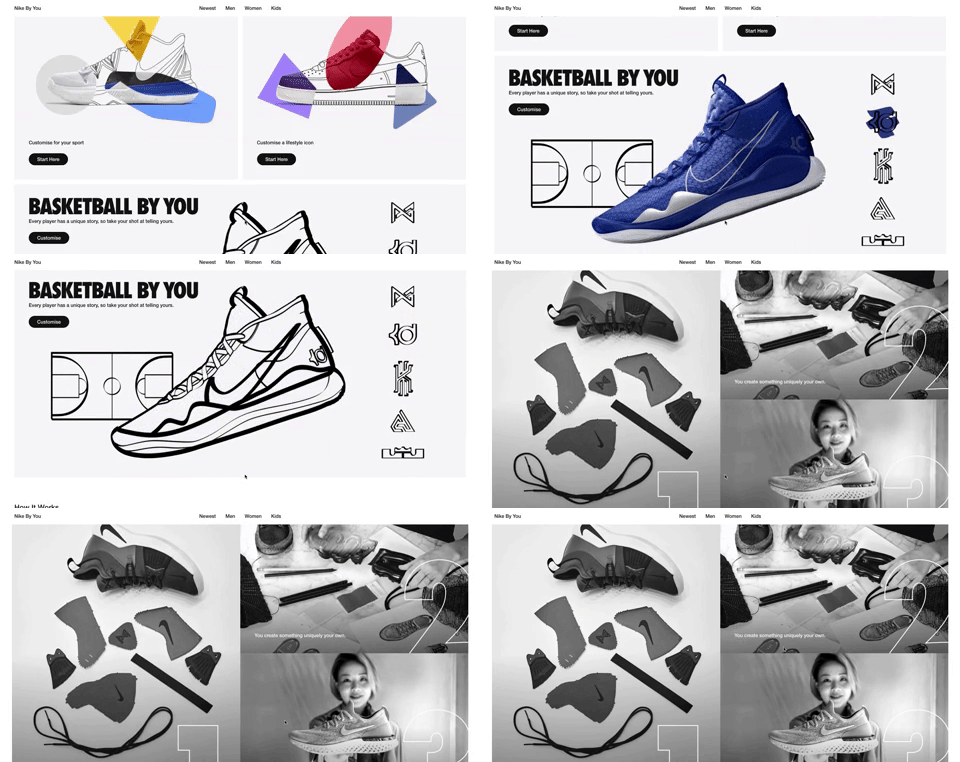
Being a customer-centric firm that’s now extra than simply the merchandise they promote, Nike additionally takes a stance on political and social points with their business advert methods. While digitizing their omnichannel CX, they’ve constructed a Nike loyalty App that serves product suggestions, in addition to charting wellness and exercise (as soon as extra highlighting their concentrate on promoting advantages over merchandise).
Key Takeaways for Marketers
- Be passionate in regards to the product you’re promoting. Nike’s founder (Bowerman) had the last word aim of selling operating. If you consider in the advantages of your merchandise, then your advertising will resonate deeper together with your clients.
- Nike has been round for many years and is internationally standard as a result of they’re able to change and capitalize on well timed and related points: be adaptable and versatile in accordance with your clients’ wishes, wants, and political inclinations.
- For mass-merchant retailers, modernizing legacy know-how is necessary.
- In addition, cultural change and buying new expertise is commonly a necessity. Nike copes equally by evolving over time, staying forward of the modifications, and scaling superior personalization (this generates loyalty).
9. Wegmans

Aside from Disney, Wegmans has been ranked because the strongest word-of-mouth advertising firm on the earth. People love Wegmans. This meals retailer remains to be referred to as a family-owned firm, which commits to their workers in unparalleled methods – $50 million was contributed in 2017 to worker improvement.
Global knowledge synchronization
Wegmans’ provide chain is exclusive as a result of they management your complete distribution course of. They additionally successfully sync their knowledge with native and nationwide suppliers, which signifies that their product knowledge is constant and harmonious. This leaks all the way down to their clients, after all, as a result of procuring at Wegmans turns into streamlined, the inventory is all the time established, and there may be by no means an sad buyer. Wegmans additionally has neighborhood outreach donation packages, they usually satisfaction themselves of their bodily presence (brick-and-mortar shops).
Key takeaways for entrepreneurs
- Build genuine relationships together with your clients and staff to maintain clients and workers loyal and get them speaking in regards to the trustworthiness of your organization.
- Build your model picture as one that’s credible and resilient (regardless of the recommended “death of brick-and-mortar”, Wegmans survives).
- More than this, preserve your buyer delighted. Data and know-how are nice, however these needs to be harmonized protecting the shopper in thoughts.
Conclusion
Customer-centricity is essential for any competing enterprise. But innovation in customer-centricity defines the success of those larger retailers. What these 9 brands have taught us is that customer-centric approaches are a key defining function in buyer loyalty and retention, in addition to model fairness and intimacy. What we’ve realized from customer-centric success is the next:
- Delivering extremely related experiences = greater income raise
- Continuously tailoring the procuring expertise to particular person clients by utilizing knowledge = elevated loyalty, and buyer satisfaction
- Don’t overlook that human contact = model fairness, buyer loyalty, extra gross sales
Nikole Wintermeier is the Copywriter at tech-company Crobox in Amsterdam. She invests in beer, basketball, and books. Big fan of psychology and alliteration.